
Photo: David J. Golia
Form is the shape of content.- Ben Shahn (1898-1969)
Part Two: Formation
“Broadway was big back then, when I started writing tunes and lyrics in 1968. I was working in the Poconos and the hotel had a dining room with a half-step platform and an upright piano; it was quiet there late at night and if you played softly they let you use the piano. One night after we’d finished playing, I was at the piano working on one of my first pieces, and I had some issues with the music versus the words. The hotel’s activities director came in with a girl on his arm…they saw me, both stopped (I’m picturing this in my mind), and when I told him my problem he said, ‘Remember that music is very pliable,’ and this stayed with me. What he meant was that you can make a long note short and vice versa, stretch out the words, space your ideas, which is a big thing. You’re not pouring something into a preconceived mold. The ‘something’ shapes itself.”
When Frank decided to write music he started studying jazz piano and harmony with Michael Melillo (1939 – ) to improve his skills.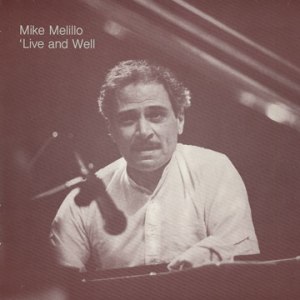 Here’s Melillo playing “Remembrance” and the afternoons Frank spent with him were more than memorable. Melillo introduced him to the music of Charles Ives and of Edgard Varese, and knew his widow, Louise Varese (1891-1989), who lived in the hills of Sussex County, New Jersey. (See ‘Points of Reference’ main menu,)
Melillo had worked with alto saxophonist/bandleader/composer Phil Woods and later lived in Italy where he recorded with Chet Baker (Symphonically, Soul Note Records, 1986). While not particularly well known in America, the Italians refer to Melillo as maestro. More than a piano teacher, he was a mentor who expanded Frank’s musical horizons. Frank had always loved different musics and now read everything he could find about Varese, including the biography by Louise (Varèse, A Looking Glass Diary , 1972).  Louise translated the works of Stendhal, Proust, Rimbaud and others from French to English and found an unexpected patron in Frank Zappa, a fervent admirer of her husband’s work.
Around the same time (1968-1969) Frank appeared on Al Albert’s Showcase, a variety show hosted by the singer/composer that featured young musical talent. Soon after, he married a girl he’d known before Lois, but it didn’t last, and while he maintained several long-term relationships, he never married again. All of his energy and financial resources were now dedicated to his music. For many years, he lived with our mother’s sister Sophie. A widow who had raised her only son to be a doctor, she assisted her youngest sister’s firstborn child however she could to pursue his career, as she would have done had she lived. Loretta, the second sister, who likewise raised her two sons on her own, was also a formative presence in our lives. Both had spent decades installing light-bulb filaments at the Westinghouse factory in Trenton. They were hardworking women who loved music and were fiercely devoted to their families.
“I listened to all kinds of music, Tibetan chants, Bulgarian folk songs…this was before ‘world music’s’ popularity; it was just the best way to develop an understanding of other cultures, especially when you were too young to travel.”
From 1971-1973 Frank studied with Joe Morello (1928-2011), “a virtuoso on the drum set” who had played with Dave Brubeck for twelve years, including on Brubeck’s hit album Take Five (CBS, 1959). Morello’s approach to his instrument, from the melodic and literally hands-on to the complex multi-rhythmic, is on display in this killer solo with the Brubeck band.
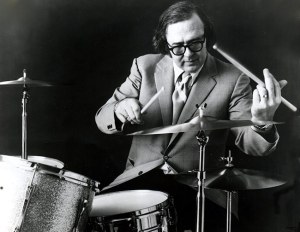
Mike Melillo, photo: Drummer World
Frank had heard and met Morello at the Lambertville Music Circus in his teens, when our mother still ferried him around to rehearsals and performances. He didn’t start driving until he was nineteen and equipped with special corrective eyeglasses that allowed him to pass his exam. He had this in common with Morello, who couldn’t drive at all owing to his poor eyesight; he wore thick glasses and eventually was obliged to get around with the help of a seeing-eye dog. Frank and Morello became friends and aside from adding to his “overall facility” on drums, Morello’s approach to teaching proved helpful when Frank began giving lessons himself. While working at Strickland’s in the Poconos, Morello arranged an introduction to the piano player with Tony Bennett who was performing at the nearby Mount Airy Lodge, so that Frank could show him two recently written tunes. The pianist liked “Summer Days” and ‘The Last Time I Saw Her” and promised that Tony would perform at least one of them, but it never came about.
In search of new techniques and challenges, Frank left Morello to study in New York with powerhouse percussionist Elvin Jones (1927-2004), a pillar of John Coltrane’s historic quartet (with Jimmy Garrison/bass and McCoy Tyner/piano) from 1973 to 1975. Elvin gave lessons at Frank’s Drum Shop on 9th (or 10th) Avenue, as did Philly Joe Jones and Joe LaBarbara. Elvin encouraged Frank’s songwriting, and particularly liked two jazz pieces he’d written, “Subito” and “On the Street.” Frank visited him and his wife Keiko at their home and stayed in touch with Keiko long after Elvin’s death.

Elvin Jones, photo: Jimmy Katz
“You had to be at a certain level to pick up what [Elvin Jones] was showing you. It wasn’t formal in the sense of advancing from one thing to another. Elvin spoke in parables and/or grunts, playing what he wanted to show you. You had to be up for it.”
Between lessons and outings to clubs and lofts to hear the musicians he admired, Frank was in the city a lot, and with our brother David and friend and fellow drummer Rick Fiori, he attended a 1975 Miles Davis concert in Avery Fisher Hall. The fusion direction Miles had taken with Bitches Brew (Columbia, 1970) and On the Corner (Columbia, 1972) while congenial to a wider audience, suggested to Frank that jazz had had its day. The ‘free jazz’ approach to improvisation and composition pioneered by Cecil Taylor and Ornette Coleman among others, however provocative and inspiring for aficionados, was hardly commercial and never attracted large crowds. Jazz, said Frank, was becoming “a closed circuit TV.” While still interested in playing, he wanted “to become more rounded [by] learning other kinds of music” and, above all, he wanted to compose.
In the early 1970s Frank found work on demo recordings for singers and “jingle work” i.e. music for advertising. In the summer of 1975, while attempting to repair his stalled car on a roadside, he lost the better part of the top joint of his right index finger in the engine. The accident might have cost him a hand and his career as a performer, but as it was, he was back to work within a month. For a year, he studied with drummer Ed Soph (1945 – ) who had toured and recorded with Stan Kenton, Woody Herman and Clark Terry before settling into a career as a professor of jazz studies. By the later 1970s, Frank was working days in Philadelphia as a security guard, gigging whenever possible and getting his first composite scores for multiple instruments down on paper as best he could.
He needed a composition teacher but at age 30, lacking a college background, it wasn’t easy finding one. The City University of New York wouldn’t have him as a part-time student, but he’d heard that Andrew Rudin was teaching at the College of Performing Arts in Philadelphia, so he sent the head of the music department several of his compositions. The response was literally music to his ears: the department head told him he had talent and potential, and he was soon enrolled in Rudin’s class.
Frank became interested in electronic music in the early 1970s, when there were few schools that taught it; “You had to buy the equipment, read the manuals, and maybe go to a seminar.” Rudin had met music synthesizer inventor Robert Moog the late 1960s, and was deep into it. Director Federico Fellini used some of Rudin’s synthesizer compositions as the soundtrack for Satyricon (1969) and Nonesuch Records commissioned him for Tragoedia (1968) their second electronic music release. Through Moog, Rudin acquired a synthesizer for the College of Performing Arts, facilitating studies for musicians like Frank. A distinguished educator, Rudin was recently recognized by the American Academy of Arts and Letters; he taught at the Philadelphia Music Academy and later, at Julliard, where he offered seminars in the opera of the 19th and 20th centuries, one of Frank’s particular interests.

Frank wearing the traditional Egyptian gallabiyya with an un-tradtional fedora, at my place in Cairo, c. 1981.
The work with Rudin lasted seven years, first in Philadelphia and later in Rudins’s New York home. Frank meanwhile started a group called Improv Unlimited (1979-80) with saxophonist Fred Hess (1944-2018) who had also studied with Phil Woods and was influenced by free jazz players like Eric Dolphy and Anthony Braxton. They worked with synthesizers and 8-track tape; Frank’s elaborate percussion set-up comprised different kinds of drums and sound-making objects like those sometimes used by the Art Ensemble of Chicago. It was pure experiment and Frank enjoyed producing what he referred to as “some pretty wild shit.” After Hess earned his master’s degree from Rutgers he moved to Colorado to pursue his career as bandleader and educator, and he and Frank lost touch.
Frank renewed his childhood friendship with our cousin, Samuel Bellardo (1938-2007) a concert pianist who had graduated from Julliard and who took Frank under his wing. A composer and gifted educator, Sam used his affiliation with Kutztown University (Pennsylvania) to help establish international music studies and performance programs in Italy, where he spent his summers.
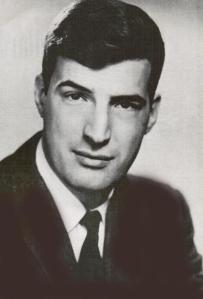
Sam came to the house to give Frank lessons in harmonic analysis and counterpoint every Tuesday, from 1980 -1982. A thoughtful, erudite and generous mentor, Sam remained close with Frank throughout his life, collaborating on Frank’s project to compose an opera based on Emile Zola’s epic novel, Germinal (see ‘Compositions’ page, main menu).
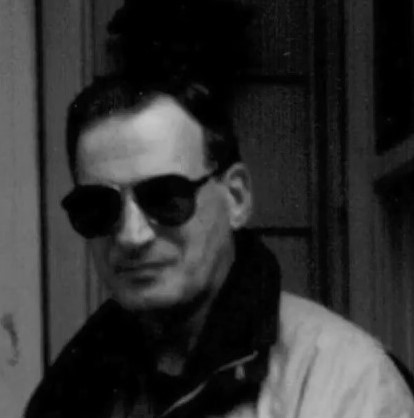
Sam, above left, in his Julliard days, seen here c. 1990s. Hear his In Paradisum, from Missa De Profunctis Requiem for soli, chorus and orchestra, performed in 2013
In the early 1980s, Frank studied at Bucks Country Community College (where Sam also taught) which had an electronic music lab with a Juno 106, a mini-MIDI analogue and some older analogue synthesizers. But he also taught there, from 1982-1983. He’d been giving private drum set lessons since 1980 teaching all facets of jazz and funk techniques in the studio he’d constructed in the basement of our Aunt Sophie’s Trenton home, which also housed his extensive collection of records and music magazines. At Bucks County College he developed a new course entitled ‘Drum-Set, A Video Approach’ at a time when instructional videos were increasingly available but students lacked the means of interpreting them. The drummers featured in these videos were not always good at explaining what they were doing, and were often demonstrating only a particular style.
Frank’s class opened discussions comparing different techniques and styles, while encouraging students to develop their own voice on drums. One of his many students was Cheech Iero, who became a writer for Modern Jazz Drummer and other music publications, and later had students of his own, including John Lennon’s son, Julian.
“My background enabled me to analyze and extrapolate stuff from what were meant to be teaching videos, but were mostly just performances that didn’t clearly communicate the points to be made. The drummers are moving fast and playing with other people. So I would demonstrate on the instrument, doing a breakdown of the sound and technique, helping students unpack what was being done on the video to help them to get to that sound.”
Following the success of the Bucks County College class, Frank helped organize day long jazz workshops for the bands at local high schools and colleges that competed on a regional and national basis and took their work very seriously. He and other professional musicians performed for the school’s band, and vice versa. Then each musician worked with a group of students (depending on their instrument) to offer feedback. An article on the interactive method appeared in Instrumentalist, an American monthly magazine for music educators.
From 1987-1988 Frank studied jazz and commercial arranging in New York with Don Sebesky (1937 – ). A well-known and versatile multi-instrumentalist/arranger/composer, Sebesky had worked with jazz musicians like Wes Montgomery and Maynard Ferguson and pop stars like Barbara Streisand in addition to symphonic contexts, with the Boston Pops and the New York Philharmonic. Sebesky rented a classroom in a small music hall on the west side of Manhattan and brought a range of professional musicians to perform for the students, from members of the brass section of the Mel Lewis/Thad Jones Band, to the principle harpist of the New York Philharmonic. Sebesky’s assignments focused students’ attention on first principles, i.e. on producing arrangements that were technically feasible rather than aesthetically interesting.
Regarding the work of composition, Frank commented:
Anyone can learn the [tonal] ranges and identify the sounds of instruments by listening and studying, but how and when you put them together, that’s the trick. That’s when you know what you know. The masters like Berlioz, Wagner, Mahler, Strauss, Rimsky-Korsakov, Stravinsky – they understood color, the blending of the instruments, as the key parameter along with rhythm, melody, harmony and form. Then synthesizers came along, broadening the color spectrum.
Like most musicians, Frank was constantly trying to reconcile his creative life with the need to earn a decent living. Writing film scores seemed like a possibility, and in the early 1990s he studied in Philadelphia with Joe Renzetti (1941 – ), who had won an Academy Award for the sound track of The Buddy Holly Story (1978).
Throughout his life, Frank’s appetite for learning remained strong. His favorite subject aside from music was world history, and his books were filled with the underlinings and marginalia of the conscientious student. Travel was an important part of his self-designed education, visits to Rome, Paris, Vienna, Cairo, Istanbul and Athens. Tracking the cross-fertilization of musical influences over time was a topic of great interest, reflected in the presentation Frank prepared for Kutztown University’s International Studies Program in Ravenna, Italy, in 1995, about the European classical tradition’s role in the development of the American jazz idiom.
As his library grew so did the volumes of experience accumulated by working squarely in the real world. He’d grown up on the bandstand, a unique vantage point for observing his fellow Americans, men and women of every background in a thousand different settings, celebrating their triumphs or dancing away their woes. The racial and gender discrimination he witnessed in the 1960s and 1970s was a source of outrage; injustice of every kind, from the small cons run in the entertainment/music milieu, to the big ones run from Washington, were a source of anger that sometimes hardened into cynicism.
Politics and the machinations of power fascinated Frank, partly for what they revealed of human nature and partly because he felt his own power to achieve notoriety and financial security was limited by circumstances not always within his control. Yet he never stopped believing that his current project was the one that would make a difference if only he would persevere. Whenever he began a new piece, embarked on a new line of study, or acquired new equipment to assist his work, he’d calculate the time it would take to gain the requisite skills to accomplish his goal – a year, five, or ten – no matter, he was patient.
The hurdles he encountered were many: finance, family deaths and debts, and in his later life severe health challenges, but he always looked to the far horizon, thinking ‘I will get past this and then accomplish that.’ He dismissed his achievements, like the public performances of his compositions (some commissioned by the Composers Guild of New Jersey then under the direction of its co-founder, Robert Pollock, with whom Frank worked closely), as stepping stones to the greater goals he never stopped preparing for by expanding his knowledge and honing his skills.
Looking back on my brother’s life, I’m reminded of an essay by Schopenhauer that speaks to our tendency to project ourselves into a future that may or may not materialize:
“The scenes in our life resemble pictures in a rough mosaic; they are ineffective from close up, and have to be viewed from a distance if they are to seem beautiful. That is why to attain something desired is to discover how vain it is; and why, though we live all our lives in expectation of better things, we often at the same time long regretfully for what is past. The present, on the other hand, is regarded as something quite temporary and serving as the only road to our goal. That is why most men discover when they look back on their life that they have been living the whole time ad interim, and are surprised to see that which they let go by so unregarded and unenjoyed was precisely their life, was precisely that in expectation of which they lived.”
Grappling with the present while keeping the past in check and the future in mind is part of what defines the human condition, but musicians have a special advantage when it comes to making the best of it. Although we’ve been taught that results are what matters, artists know that the process counts still more because the process is where we live. It is against this backdrop of everyday dramas, efforts, boons and setbacks that a musician may sometimes catch a glimpse of the sublime, when the music they are playing together or composing alone for a vivid, lasting moment, says all that is in their hearts.
 MUSIC MAKERS MATTER