
Nb. Most of the following information is transcribed from conversations with Frank in January, 2019. Audio clips appear at the bottom of the page.
“When I started writing music in the late 1960s, I needed help to get to the sounds I heard at my head, to help me navigate into those charted waters, uncharted by me. It was a step by step situation…a long trek with a lot of detours, composing while working, playing and studying… At first I wrote tunes but except for a couple that came much later, I didn’t hear that muse anymore … I think what I did write shows that there was ability. “All The Songs” used George Russell’s Lydian scales….”
“This House”, 1975 – 1977
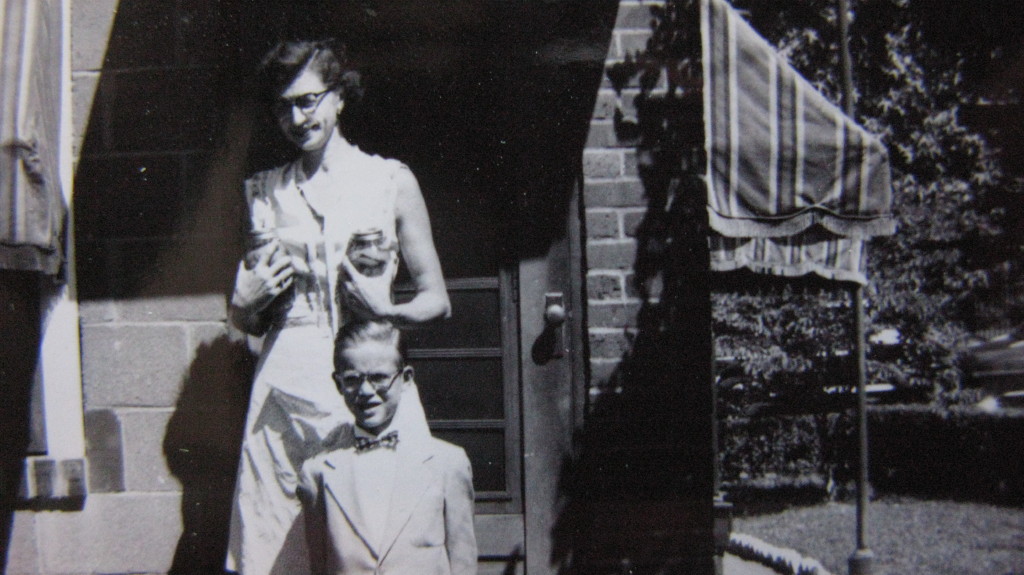
Frank and Aunt Sophie Rusnak , c. 1952, at ‘the homestead’ on Bridge Street, Trenton purchased by our Polish grandparents, where several generation of our family once lived.
This was my first composition, a piano fantasia about the house on Bridge Street. I didn’t know it was fantasia at the time. [Andrew] Rudin told me that it was. The piece has a theme but it’s loose; not a sonata form, not regimented. … I wanted it to be natural, ‘such is the life, such is the form.’ It took two years, I had no formal instruction then. This was the first piece I had performed, at the College of the Performing Arts in Philadelphia in 1977 or 78.
“Intuitions” (1977) a chamber piece for a small ensemble, never performed.
“Waiting” (1977) also for a chamber group, using multiphonics (chords with fingerings you could play more than one sound at a time). It was never performed, but there was a reading in 1980 that was recorded of an orchestrated portion called “Canticle, of which I have a composite score.
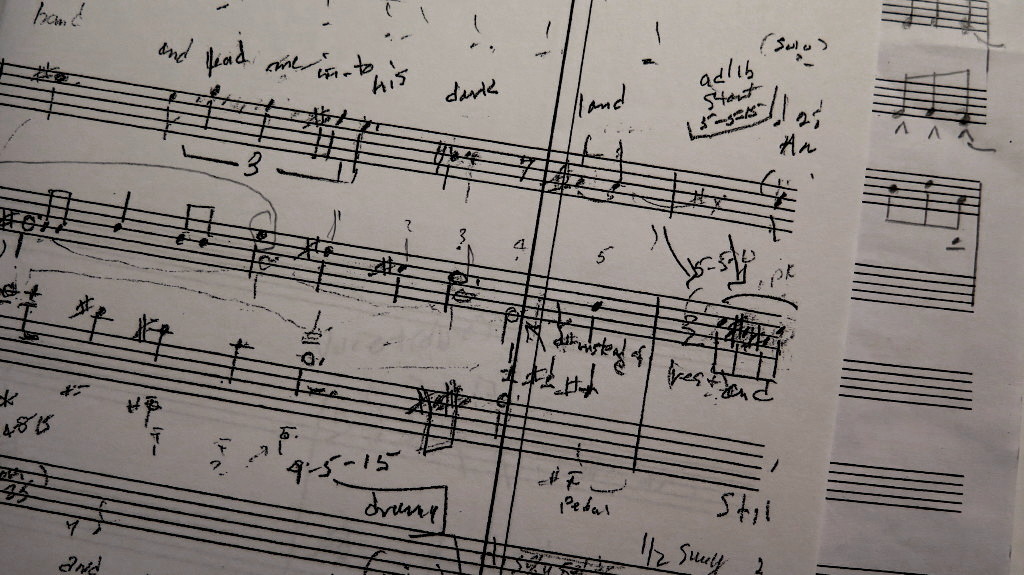
Notation, 2018. Photo: David J. Golia
“Analects” (1979) inspired by the writings of Confucius. [Nb. Frank has a composite score for this piece, and I believe it was performed but am uncertain of the details of either instrumentation or performance.]
“Ten Songs”, based on poems by William Butler Yeats, a piece for piano and vocals was performed in the Spring of 1984 at Princeton University by Judith Nicosia (soprano) and Glenn Parker (piano). the Composers Guild of New Jersey organized the performance.
“Aspects” (1985) a 3-part piece for flute, oboe, clarinet and bassoon, performed at the New Jersey Composers Concert (February 17, 1985) as part of the Performing Arts Series of the New Jersey State Museum (Trenton). [Recording of a1992 performance at the bottom of the page.]
“Origins” (August, 1989) and “The Secret Sits” (1990) were my first electron pieces and both were performed in several New Jersey planetariums, the Hayden Planetarium in New York, New Jersey SONY headquarters and at Apple Farms, a music workshop camp in south Jersey. The Composers Guild of New Jersey, to which I belonged, arranged the performances. [Nb. These two pieces were part of a performance series entitled “Music of the Spheres” that continues to this day, under the direction of Composers Guild co-founder, Robert Pollock, now based in Hawai’i.]
“Origins” 11:00

Photo: “Big Bang” by Nimit Nigam
“Origins” is a multi-synthesizer piece that evokes the Big Bang, and is meant to encapsulate everything from the birth of the universe and the formation of the solar system, to the dawn of humanity. I presented it to IRCAM (Paris) in 1994 and received great feedback, but I’d hoped for a Paris performance. The last time “Origins” was performed was in Poland , in 1997.
“The Secret Sits” was inspired by the eponymous two-line poem by Robert Frost (1874-1963):
We dance round in a ring and suppose,
But the Secret sits in the middle and knows.
A reviewer said I was writing in minimalist style, but “The Secret Sits” was three- part counterpoint. Sam [Bellardo] got it right away; he had a great analytical ear. It had nursery rhymes quoted in it, like ‘London Bridge is falling down’….
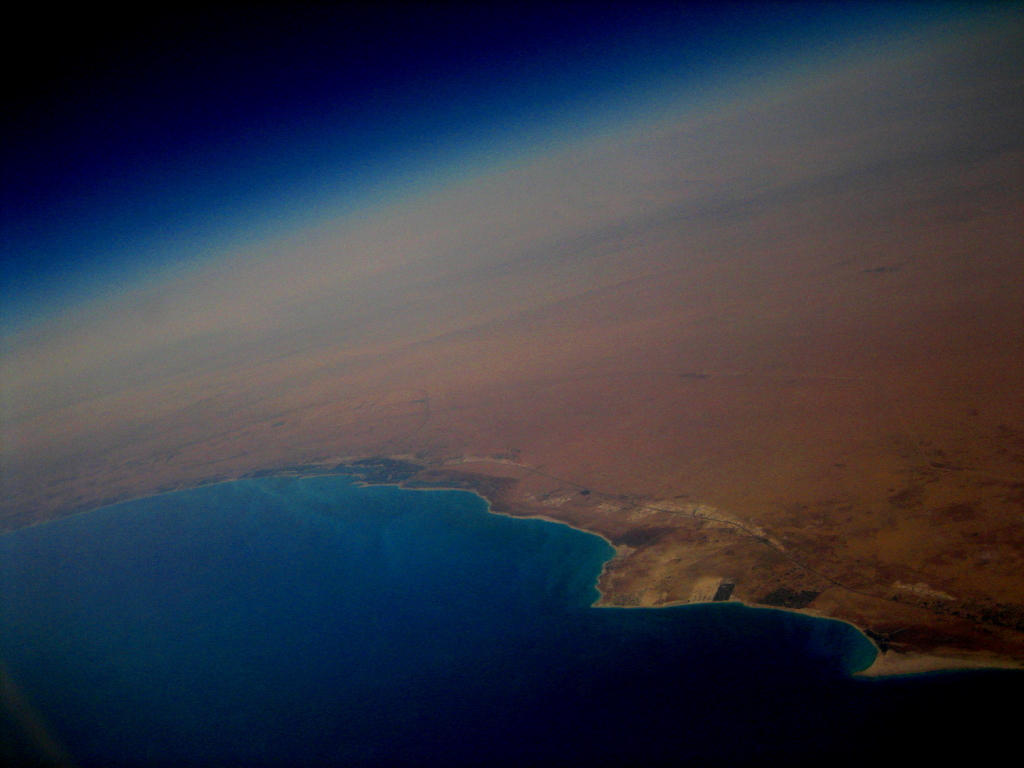
Photo: David J. Golia
“Our Earth” (1993) was based on a text by Stephen Vincent Benet written for and read by President Franklin D. Roosevelt to the United Nations on Flag Day, June 14, 1942):
Our earth is but a small star in the great universe. Yet of it
we can make, if we choose, a planet unvexed by war, untroubled
by hunger or fear, undivided by senseless distinctions of race,
color or theory.
Commissioned by the City of Trenton and the New Jersey Composers Guild, “Our Earth” is a multi-media piece for chorus, percussion, pianist and sequenced synthesizers. Two overhanging screens for slide projections were part of the 17 minute piece which was performed by students and professional musicians. PArtof a “Meet the Composers” educational program, the piece was designed as an interactive exercise where eighteen student volunteers, who did not have a music background, sang as the chorus, “Our Earth” was performed at Trenton High School, in 1993 to an enthusiastic audience. The students loved it – and never missed a rehearsal.

Photo: David J. Golia
HIATUS
Health and money issues that arose in the later 1990s derailed Frank’s work in music. Although he taught privately on occasion, he didn’t compose again until 2008. In the meantime, however, he began preparations for an opera based on Emile Zola’s novel, Germinal (1884).

Germinal, 1884
Set in the coal mines of northern France, Frank found Zola’s indictment of inequality and injustice ever-timely. The title comes from the Latin word for seed (germen), and was also the name of a month in the French Revolutionary calendar, in use from 1793-1805.
The protagonist is Étienne, who finds work in the coal pits having been fired from his former job on the railway for fighting with his boss. To Étienne, a hotheaded young idealist, the proposition of socialism, as expounded by a Russian co-worker, Souvarine, is deeply appealing, as is the daughter of a fellow miner, Catherine, who also works the mine, pushing cartloads of coal from the pits. The hardship of the miners, whose humanity peeks from beneath layers of toxic grime, forms the grist of the novel.

Filmic version, 1993
The action revolves around a workers strike Étienne helps organize that turns into a full scale revolt and is swiftly, violently quashed by the police. Having lost the support and confidence of his fellow workers, Étienne, Catherine and others are trapped in a mine shaft where their fate will be decided by those who remain above ground…
Zola’s comment on industrialization, poverty, the working class struggle and the exploitation of natural resources remains valid, and his novel, recognized as his masterpiece and translated into many languages, is still in print.
The last sentence reads as follows:
“Men are springing forth, a black, avenging army, germinating slowly in the furrows, growing for the harvest of the next century, and their germination will soon overturn the Earth.”
Frank spent years researching his subject and his chosen musical form, corresponding with scholars and acquiring and learning to use a music notation software (Sibelius). He worked closely with Samuel Bellardo, who produced the libretto for Germinal shortly before his death in 2007, and by then was writing notation sketches of his principle themes. Sam’s death was a great loss, on a personal and professional level, but Frank continued to develop aspects of the opera for the balance of his life.
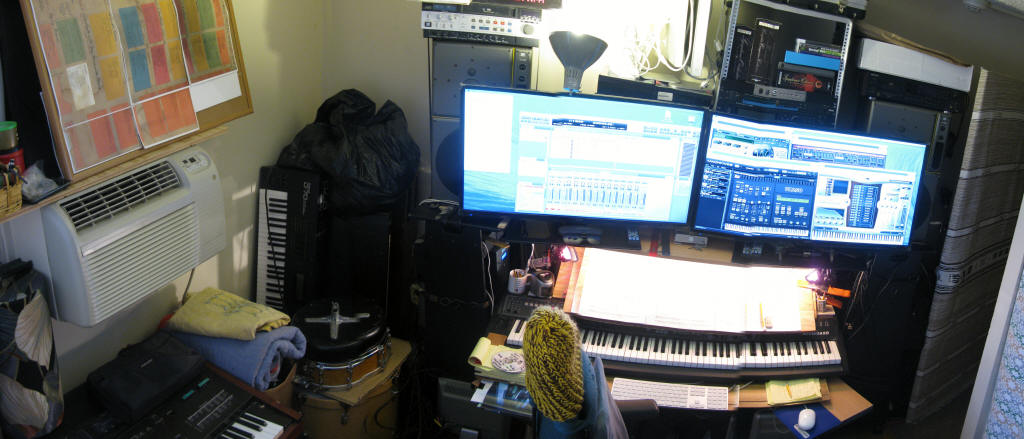
Our brother, cinematographer David J. Golia (below) helped Frank set-up the studio where he spent most of time, from 2010 – 2019. Photo: David. J. Golia
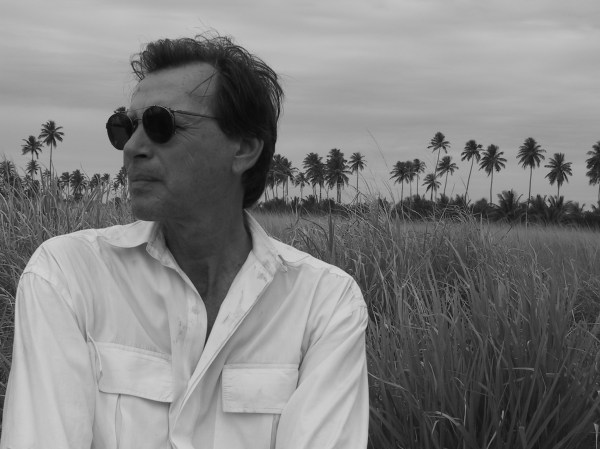
David in Puerto Rico while shooting Bad Boys II (2003) Photo: Francois Duhamel
Frank had meanwhile nearly finished a shorter piece, fatefully entitled “Rendezvous with Death” based on the poem by Alan Seeger.
As a young scholar, Seeger (1888-1916) translated Dante and helped edit the Harvard Monthly, where some of his poems appeared. After graduating Harvard in 1910 he lived in Greenwich Village for a while, then moved to Paris where he discovered beauty and if his poems are any indication, found love. During World War I Seeger chose to fight for France and was killed in the horrific Battle of the Somme while serving in the French Foreign Legion.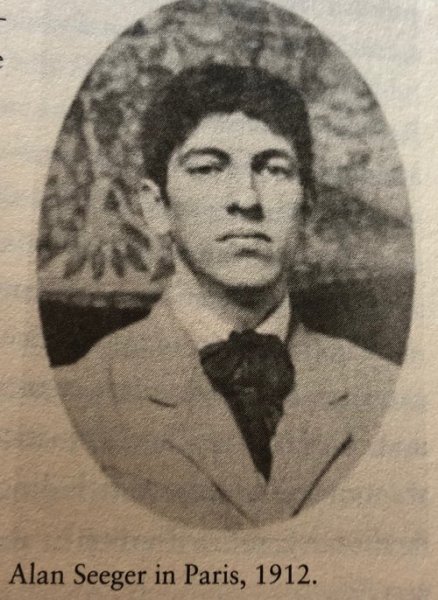
Seeger was celebrated in 2016 as a ‘hero of France’ on the hundredth year anniversary of his death.
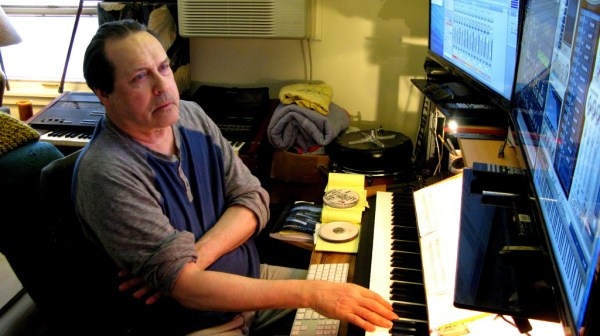
Frank in his studio, Doylestown, Pennsylvania, c.2015. Photo: David J. Golia
Several performances of Frank’s finished works were recorded on tape that we will eventually convert to digital. Meanwhile. here are several brief pieces composed using a keyboard and Sibelius software.
Frank may have considered these work experiments; some of the computer files were labeled “improvisation”. But each has a distinctive mood, and offer hints of what Frank was up to in the months preceding his death.
Rich chordal washes, scampering scales and brief bright phrases, Harp Test Variation, 5:20 reminds me of a deep and ancient forest with shafts of light streaming through.
Playfully rhythmic, deliberately electronic with an eerie lyricism, Xcursions (3:09) sounds like Frank (who wrote several pieces inspired by planetary science) had space travel in mind.
Improvised Theme and Variations: 12:11 This is my favorite (piano and synthesizer). Tender and contemplative with a sense of yearning characteristic of my brother’s work.
“Aspects” – woodwind quartet – 1985: 10:36 – 1992 Performance
 MUSIC MAKERS MATTER