

- Photo: David J.Golia
Such is the life, such is the form. – Samuel Coleridge (1772-1834)
Form is the shape of content. – Ben Shahn (1898-1969)
Frank was inspired by ideas that Coleridge elaborated in his essay on Shakespeare:
The form is mechanic when on any given material we impress a pre-determined form, not necessarily arising out of the properties of the material — as when to a mass of wet clay we give whatever shape we wish it to retain when hardened. The organic form on the other hand is innate, it shapes as it develops itself from within, and the fullness of its development is one and the same with the perfection of its outward Form. Such is the Life, such is the form. Nature, the prime genial artist, inexhaustible in diverse powers, is equally inexhaustible in forms.”
Frank also admired Ben Shahn’s book The Shape of Content and felt that the substance of a piece of music – the idea and message behind it – determined its form and consequently its sound.
In 1996, Frank wrote a short paper outlining his aesthetic position:
Having and developing an aesthetic position should be of prime concern to any artist. Whether found by trial and error or it being there more of less of its own accord is of less importance than acting upon it surely and without reservation….My own feelings towards art have developed rather slowly but surely. I don’t belong to a ‘school’. I’m not inclined towards what is fashionable or otherwise accessible at the moment. I love Bach, Debussy, Ives, Bartok, Varese and many others. Schoenberg and Berg did some remarkable things but again., all of these composers are not schools to me. Atonality, tonality, the organization of sound, minimalism, are all devices, viable ways to go if one truly has that aesthetic bent. I feel I’m at a juncture of particular importance for the purpose of an overview; looking backward and forward one can see where one came from and is going. I began with a deep love of jazz. I wrote in that genre and later in other Twentieth-century music modes, and still I know that the synthesis [of the forms corresponding to my aesthetic] for me is not yet complete. ..
Jazz was Frank’s point of departure, and one of his close companions in that journey was Rick Fiori, with whom he shared numerous adventures, mostly in New York were they devoured as many jazz gigs and loft jams as possible. Sometimes they hung around outside the clubs before the show in case they could convince their heroes to let them carry their equipment and meanwhile squeeze in a burning musical question or two.

Rick Fiori, c.2010
Rivbea was a happening place in the early 70s, the loft of saxophonist Sam Rivers and his wife where informal concerts were held. Frank and Rick saw Anthony Braxton there, among others. They spent a lot of time (and money) at record stores in those days, flipping through the racks, reading the liner notes to help determine their purchase. Nonesuch Records was a great label for experimental music sold at around half the price of other lps as part of their policy to make their records the equivalent of paperback books- i.e. available to the widest possible audience. Elliott Carter, who Frank admired, recorded on Nonesuch, which also commissioned and released Charles Wuorinen’s Time’s Encomium (1969) the first electronic composition to win a Pulitzer Prize (1970).

Rick and Frank, c.2010.Rick is still gigging and working days as a barber, a profession he adopted in the 1970s to supplement his income as a musician.
Here’s Rick sitting in with James Stewart – tenor, Dan Kostelnik – organ on March 6th, 2018 at the Candle Light Lounge in Trenton. They’re playing “Second Balcony Jump” an Earl Hines composition with a little known backstory having to do with another famous piece, “Flying Home”. The 1942 live recording of “Flying Home” by the Lionel Hampton Band featured then 19 year-old Houston tenor saxophonist Jean-Baptiste Illinois Jacquet (1922-2004) whose solo created a sensation (and still does, judging by the number of downloads of its transcription.). Malcolm X tells the story of “Second Balcony Jump” in his autobiography, describing a performance of “Flying Home” at Harlem’s Savoy Ballroom in the early 1940s:
The people kept shouting for “Flying Home” and finally, [Hampton] did it. (I could believe the story I’d heard in Boston about this number – that once at the Apollo [Harlem], Hamp’s “Flying Home” had made some reefer-smoking Negro in the second balcony believe he could fly, so he tried – and jumped – and broke his leg). ..I have never seen such fever-heated dancing…
-The Autobiography of Malcolm X, as told to Alex Haley, (New York, 1962) p.74

Photo: David J. Golia

Edgar Varese (1883-1965)
“It all comes down to what is music… there’s no such thing as noise, if you can cast it, place it in the right place. Varese said music is ‘organized sound’ and I agree.” Francis J. Golia
Frank discovered the work of Edgar Varese in the late 1960s. One of the first composers to use multi-channel tape, Varese wrote Ionisation for 13 percussionists, the first composition to use this kind of instrumentation.
Check out Varese’s pioneering composition Poème électronique (1958) commissioned for the opening of the Philips Pavilion (Philips was a Dutch electronics company) which was designed by Le Corbusier for the 1958 Brussels World’s Fair.
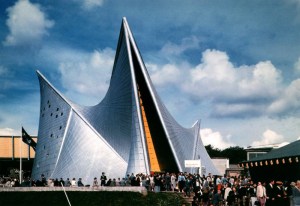
Check out Varese’s pioneering composition Poème électronique (1958) commissioned for the opening of the Philips Pavilion (Philips was a Dutch electronics company) which was designed by Le Corbusier for the 1958 Brussels World’s Fair.
Listening to Varese, Frank became interested in electronic music, and in the mid-1970s he drove up to Williamsville (near Buffalo) New York to visit Robert Moog’s synthesizer factory, which didn’t look like much from the outside, but was nonetheless at the heart of a musical revolution…

Harry Partch, 1901-1974
Frank was interested in the development of the tempered scale, and naturally pitched, versus tempered instruments. Harry Partch was consequently one of his heroes:
“Harry Partch was ‘organizing sound’ in the 1930s; he was a hobo and made his own instruments that worked outside of the tempered scale. It’s called ‘just intonation’ , following the natural pitch and harmonics that exist in nature. A keyboard is artificial. ‘Just intonation’ has a different sound. There were two versions of the tempered scale well into the 19th century. When one was finally settled on, it was considered an advance. But 20th -century composers realized there were many avenues for diversion….”
Elliott Carter (1908-2012) was another composer Frank admired, partly because he so often drew musical inspiration from the work of poets, as did Frank (see ‘compositions’ page)….
More ‘points of reference’ to come….
 MUSIC MAKERS MATTER